


Asia is now a powder keg with several fires lit at the same time.
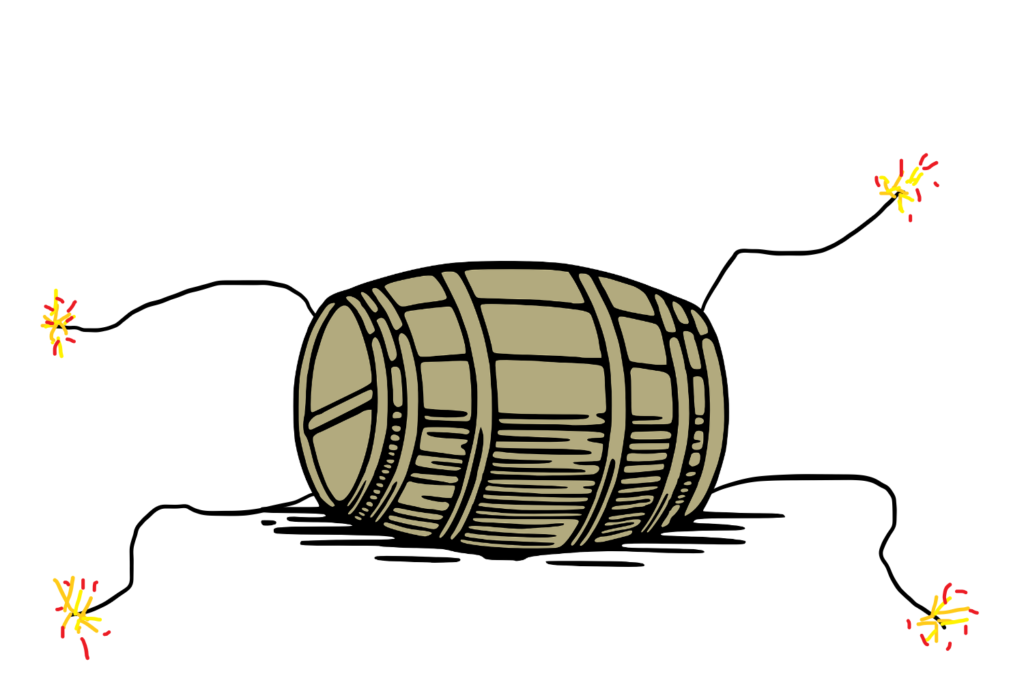
There are at least four conflicts in Asia from which neither side can afford to retreat because the stakes are too high, there is no prospect of overcoming, and retreat would mean losing the whole struggle.
They are:
- US vs. China over trade.
- China v. Hong Kong over the status of Hong Kong.
- India vs Pakistan over Kashmir.
- Iran in the Persian Gulf.
Let’s go one by one, in no particular order:
INDIA VS. PAKISTAN
A few days ago, India canceled the special status of “its half” of Kashmir and absorbed it into the country. This was accompanied by the build-up of troops (including from Pakistan) and the transition of the territory to a almost complete blocking.
In addition to cementing Indian claims to the territory (which is disputed by Pakistan, both countries claim all of Kashmir), the move guarantees the end of the Muslim majority, allowing Indians to buy property and move. This is definitely the plan.
Pakistan cannot afford to let it go and India cannot back down.
It is important to know that Kashmir is also the source of almost all of India’s water, so controlling the region is strategically important.
To add fuel to the fire, both Modi and Khan face domestic audiences – regime hardliners and ultra-nationalist, religious chauvinist voters – who push them into opposition and chastise them for being seen as “soft” on the enemy. So they may be forced to escalate against their own judgment – especially Mr Khan, while Mr Modi is currently escalating entirely on his own accord.
Both countries have nuclear weapons. In terms of conventional armies, however, Pakistan was completely outmatched. In the event of war, Pakistan may be tempted to launch nuclear weapons.
Well, Pakistan has a special defense relationship with China, which is India’s main regional rival. You can see how things can get out of hand.
USA VS. CHINA
Probably the biggest story in the world right now: The United States and China are locked in a (so far mostly economic) superpower struggle.
Trump announced new tariffs on Chinese imports, China devalued its currency and sent global markets into a tailspin, Trump called China a currency manipulator.
The stakes are high. If the US allows China to continue on its trajectory, the loss of economic superiority and geopolitical hegemony will be a matter of time, if not already. China will never be weaker than it is now, so now is the best time to act.
(Actually the optimal time to act was the 1990s, but the Western world was intoxicated by the self-aggrandizing mythology of the “end of history” and assumed that China, like Russia, would liberalize and join the international order. China and Russia saw this as a trap and refused to do so.)
The US believes it cannot back down or China will rule the world.
China, in turn, believes that it is impossible to retreat, because it would mean accepting a subordinate role in world affairs and forever being in the shadow of the United States. In their current national narrative of “returning China to its rightful place at the center of the world,” this is simply not an option.
The fight has absolute chances for both sides.
This is a decisive confrontation that will change the relative and absolute trajectories of both countries for the rest of the century.
China rose peacefully, but they never said they would continue to rise peacefully.
Internally, Xi Jinping is likely to be under enormous pressure – the CCP’s (Chinese Communist Party) rule is based on ensuring prosperity – in the event of a major economic blow, the regime could become extremely precarious. Revolution and civil war are not impossible. In this regard:
CHINA Vs HONG KONG
If the protesters in Hong Kong return home, it means that Hong Kong has special status and protection under the treaty – it will be completely absorbed by China (in violation of Chinese promises), no doubt with some disappearances of dissidents and local politicians.
Nor can the Communist Party back down because it cannot afford a successful challenge to its rule.
Meanwhile, Hong Kong is not only Hong Kong – it is also Taiwan. With its current treacherous attitude toward Hong Kong, China shows that the promises of “One Country, Two Systems” it is trying to lure Taiwan into reunification are empty and will be abandoned, as they are now being abandoned in Hong Kong.
(Fun fact – the government of Taiwan, in turn, considers itself the legitimate government of all of China.).
The Chinese know what they fear – the entire history of China has been a cycle of imperial consolidation and division into warring states, as well as rebellion against violent rebellion. China is always ready to tear itself apart at the first sign of central government weakness and/or at the first hint of an economic crisis. Now faced with the direct possibility of both at the same time.
All of these situations, with the possible exception of Iran’s attempt to control Hormuz, are uniquely dangerous because all players cannot back out of their bets.
In addition to the great difficulty of de-escalation, all these situations can trigger wider conflicts. This can get nasty – Asia is not exactly known for restraint and humanitarian issues in war, and there is something special about China – its conflicts have been the bloodiest in history.
An Asian land war involving China or a Chinese civil war would threaten the death count, making WW1 and WW2 rounding errors. Hundreds of millions of casualties are not impossible – by some estimates, the Chinese cracked the nine-figure death toll during The Taiping Rebellion in the 19th century, without modern weapons. It is better not to imagine what they can do with them.
Therefore, let’s hope for four miracles.
If you liked the article, give it a second thought bought me a nuclear shelter.